Compression is what makes a vocal sit: every word at a steady level, close to the listener, never disappearing behind the beat. It's also easy to overdo. This guide explains what each control does, gives starting settings by genre, and shows why serial compression is the secret behind most polished vocals.
What each control does
- Threshold: the level where compression starts. Lower it and more of the vocal gets compressed.
- Ratio: how hard it compresses above the threshold. At 4:1, a signal 4 dB over the threshold comes out 1 dB over.
- Attack: how fast it reacts. Fast attack catches peaks but can dull consonants; slower attack lets the front of words through, which keeps punch.
- Release: how fast it lets go. Too fast and it distorts or flutters; too slow and it stays clamped down and pumps.
- Gain reduction: how much it's actually turning down. This is the number to watch.
- Makeup gain: turns the result back up so you compare at the same loudness.
Starting settings by genre
Rap
- Ratio 4:1 to 6:1, attack 5 to 15 ms, release 50 to 100 ms (matched to the flow), 5 to 8 dB of gain reduction.
Pop
- Ratio 3:1 to 4:1, attack 10 to 20 ms, release 80 to 150 ms, 4 to 6 dB, followed by a second stage for peaks.
R&B and ballads
- Ratio 2:1 to 3:1, medium-slow attack, smooth release, 3 to 5 dB, plus a slow leveller to even out phrases.
Treat these as starting points and set the final values by ear.
Set the release to the rhythm
The release should let the compressor recover in the gaps between words. A fast flow needs a faster release; a slow, sung line can take a longer one. Watch the gain reduction meter: it should fall back between words, not sit permanently down.
Serial compression: two or three gentle stages
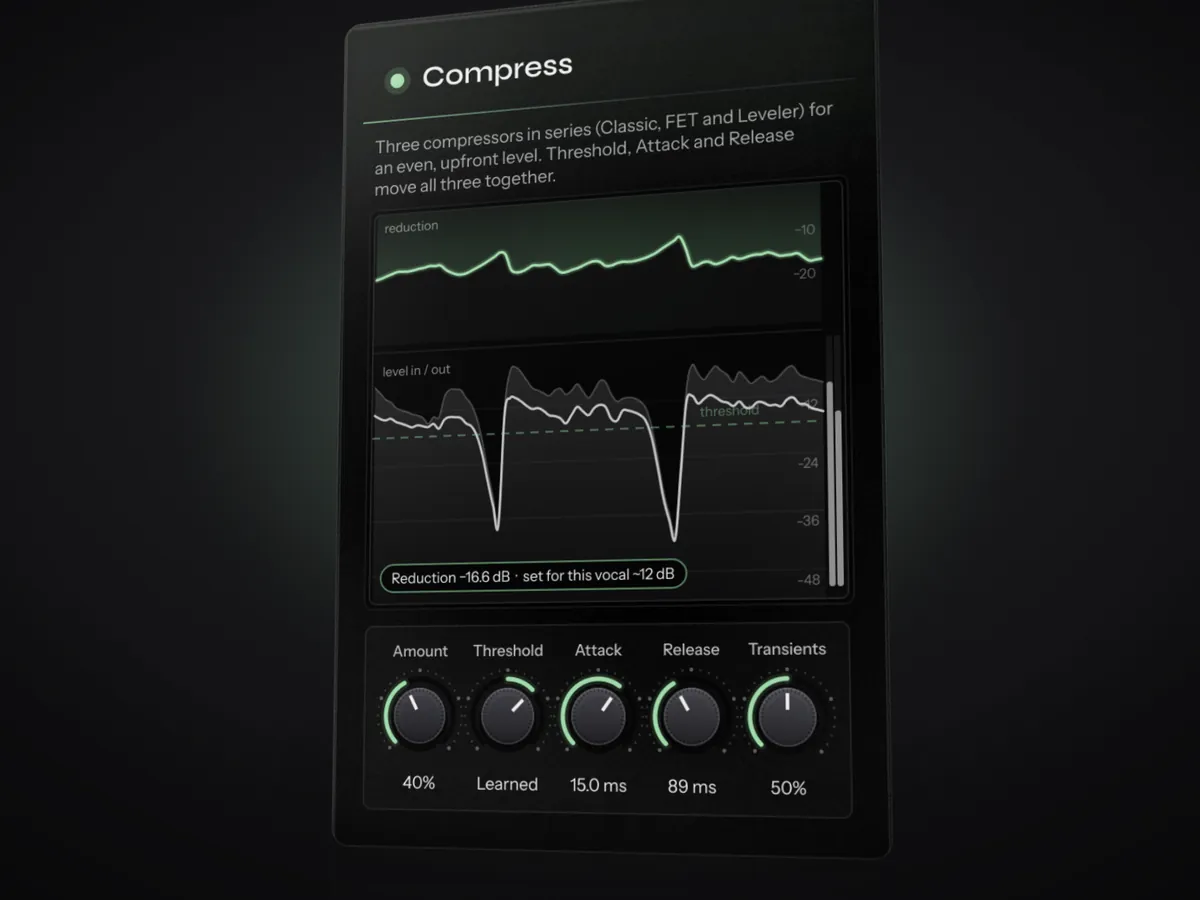
One compressor doing 12 dB of gain reduction sounds squashed. Three doing 3 to 4 dB each sound controlled and natural. A classic chain:
- A shaping compressor (smooth, medium attack) for the overall level.
- A fast, FET-style compressor catching the peaks the first one missed.
- A slow leveller riding the loudness between phrases.
Parallel compression
Send the vocal to a heavily compressed copy and blend it under the original. You keep the natural dynamics and add density and loudness. Great for rap and aggressive vocals.
Where compression goes in the chain
- Cleanup EQ (high-pass, mud cuts) before compression, so it doesn't react to rumble.
- A light de-esser before or after, since compression brings esses up.
- Tonal EQ (presence, air) after.
- Effects on sends at the end.
The rap vocal mixing guide shows the full chain in order, and the vocal EQ cheat sheet covers the EQ side.
How Instinct sets the compression
Instinct uses three compressors in series (a Classic, a fast FET-style and a slow Leveler) and sets them from your recording. It measures how much your vocal's level moves (the spread between its louder and quieter moments) and sets the amount from that, so a dynamic take gets more control than an even one. It sets the release from the spacing of your syllables, so the compression breathes with your delivery. Threshold, attack and release stay open if you want to change them. See how Instinct analyses a vocal, or download the free beta.
Common mistakes
- Too much gain reduction in one compressor. Spread it out.
- Release too slow. The vocal pumps and loses energy.
- Attack too fast on rap. The consonants lose their punch.
- Judging louder as better. Match the output level when you compare.
FAQ
What is a good compression ratio for vocals?
Between 2:1 and 4:1 is a good starting range for most vocals. Rap and aggressive styles often go to 4:1 to 6:1. More control usually comes from using two or three gentle compressors in a row rather than one with a very high ratio.
What attack and release should I use on vocals?
Start with a medium attack (10 to 20 ms) so consonants keep their punch, and a release that recovers between words, often 50 to 150 ms. Faster attack gives more control; slower attack keeps more life.
How much gain reduction is too much on vocals?
If you hear pumping, breathing noise rising between words, or the vocal losing its energy, it's too much. As a rough guide, 3 to 6 dB per compressor is a good range, spread across more than one compressor if you need more.